
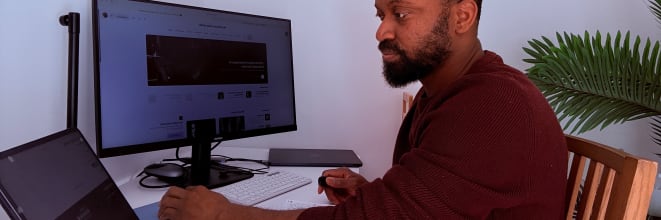


One of the most compelling experiments on human focus comes from author and productivity expert Chris Bailey. He found that reducing mental overstimulation can dramatically improve attention, creativity, and calm. In today’s world of digital overload, our ability to stay focused has dropped to unprecedented levels, averaging around 47 seconds on a screen.
You have probably never been more distracted than you are right now. And it is not by accident. The most sophisticated attention-capturing technology in human history is deployed against you every day. Every app, every notification, every feed is engineered by brilliant minds with one goal, to keep you looking a little longer. Not recognising this is, makes it possible for them to deposit their agenda in your brain rent-free.
Focus is now a finite resource. Like muscle energy and time, it depletes with use and restores with rest. Every decision you make, every interruption you process, every tab you switch drains it. The real question, then, is not just what to focus on but how to protect your capacity to focus in the first place. Otherwise, it will be wasted on the background noise.
There are three levels of work based on the degree of focus you give:
Deep work
Shallow (surface or maintenance) work
Deep in the Noise
Noise gives no room for meaningful work to thrive. Shallow work maintains the status quo—it rarely makes things worse, but it never takes them far either. It is necessary, but limited.
Deep work, however, is where creativity lives. It is the taproot of meaningful progress. If you do not actively block out the noise, you will never do deep work; distractions are too powerful.
Deep work requires full presence on something difficult and meaningful, producing results that a distracted mind cannot replicate. An hour of genuine focus beats four hours of distracted effort, not slightly, but dramatically. When you are fully present, you become a different worker, a different thinker and an entirely elevated version of yourself.
The enemy of focus is not just technology; it is the optionality and growing impatience we have in life. The constant pull that tells you that you should be doing something else, you should be somewhere else, for someone else, all at once. It is the urge to juggle a corporate job, a business idea, a side hustle, and endless notifications simultaneously.
Focus requires the courage for exclusion—the ability to say no to good things so that great things have room to grow. Every “yes” is a “no” to something else. A focused life demands that you make that trade consciously and unapologetically.
Protect your time like it’s your life, because it is your life in bits. The reactive time, and the creative time. Guard the early hours of the each day, before emails and requests begin, those are the moments your mind is at its best. Guard that time deliberately—it is one of your most valuable assets.
“The successful warrior is the average man with laser-like focus.”
— Bruce Lee
Try blocking a 90-minute productivity window tomorrow morning. No phone, no email, no switching tabs. Focus only on your most important task. Do this daily for the next 30 days and observe the difference it makes.
Clear your mind of the noise that crowds out what truly matters. As a doctor, I would argue that minimalist phones and simplified digital environments could be of medical benefit to those overwhelmed by confusion.
Thank you for taking the time to read this write-up. I look forward to more writing that resonates with you, as well as seeing your likes, comments. That is how I know if it resonates with you.
By the way, this is an updated writing from the one published in TGM. I had to close down the publication because I wanted to be a bit more focused and have everything in one publication to help me do more deep work. It’s still about focus. I trust that God helps me focus on the work that matters most—so you can pick more value per word that you read from my writing.