


In the 1840s, inside the crowded halls of Vienna General Hospital, a Hungarian physician named Ignaz Semmelweis noticed something deeply disturbing.
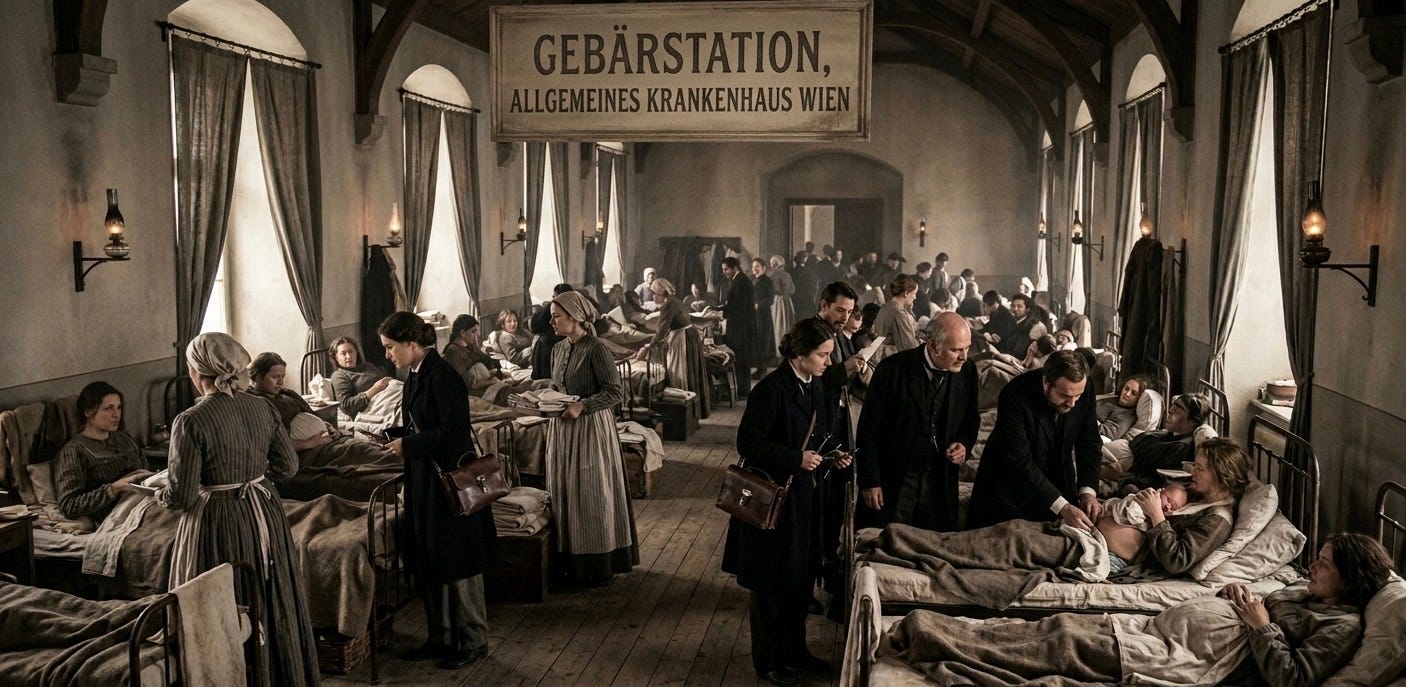
Women giving birth in the doctors’ ward were dying at terrifying rates from childbed fever — far more often than women delivered by midwives. It was not a small difference. It was a deadly one. The mortality rate in some wards climbed as high as 18%.
Semmelweis became obsessed with finding the reason. Why were mothers dying after what should have been one of the happiest moments of their lives?
Doctors were performing autopsies on dead bodies and then walking directly into delivery rooms to examine pregnant women — without washing their hands.
At the time, germs had not yet been discovered. Nobody understood bacteria. Nobody talked about infection control. The invisible world of microbes was still unknown to medicine.
But Semmelweis suspected something was being transferred from the dead to the living.
He called them “cadaveric particles” — microscopic material from corpses contaminating mothers during childbirth.
So he introduced a radical rule that every doctor had to wash their hands with chlorinated lime before entering the maternity ward.
Following that, the maternal death rate collapsed from nearly 18% to less than 2%. Thousands of lives could suddenly be saved by something as simple as washing hands.
But instead of being celebrated, Semmelweis faced fierce resistance. Many doctors were offended by the suggestion that their own hands were killing patients. The medical establishment mocked him, rejected his findings, and refused to change.
Today, however, Ignaz Semmelweis is honoured worldwide as the father of hand hygiene. His work laid the foundation for modern infection prevention, hospital hygiene, and patient safety.
And even now, nearly two centuries later, handwashing remains one of the most powerful ways to prevent the spread of infection across homes, hospitals, schools, and communities.
You may wonder, “How was it not obvious back then that doctors should wash their hands?” But the truth is that they did not know what we know today.
And that should humble us, too. Because what feels like “common knowledge” now was once a revolutionary idea dismissed by experts. It also reminds us of something important, that public health education never truly ends.
People still need to be reminded that clean hands save lives.
At home.
In hospitals.
In kitchens.
In schools.
Everywhere.
Because between one infected surface and another person stands one simple barrier: A washed hand.
Dr. Semmelweis, but he was ignored and died despised. Only after Pasteur and germ theory did the world realize he had already saved lives.